Motor Yacht A
ID#
172.1
Build/code name(s):
Project Sigma / Hull N970
Motor Yacht A
ID#
172.1
Build/code name(s):
Project Sigma / Hull N970
PRIVATE USE ONLY
PRIVATE USE ONLY
Length
119
m
/
390.4
ft
Beam
18.9
m
/
61.9
ft
Volume
5,500
GT
Guests sleeping
14
Cabins
7
Crew members
42
Main Specs
Length
119
m
/
390.4
ft
Beam
18.9
m
/
61.9
ft
Volume
5,500
GT
Guests sleeping
14
Cabins
7
Crew members
42
Estimated value
$300,000,000
Build
Shipyard
Blohm+Voss
Year
2008
Hull Type
Mono-Hull
Semi displacement
Hull Material
Steel
Superstructure Material
Steel
Aluminum
Last Refit
2025
Show more about refit(s)
Categories
Build Type
1-of-1 Custom build
Vessel Type
Yacht
Mega yacht
Categories
Build Type
1-of-1 Custom build
Vessel Type
Yacht
Mega yacht
Design
Exterior
Philippe Starck
Main Color
Grey
Silver
Interior
Philippe Starck
Amenities
Indoor cinema room
Elevator
Swim platform
Tender garage
Observation Lounge
Spa
Sauna/Steam room/Hammam
Massage room
Gym
Swimming pool
Jacuzzi
Helipad
Build
Shipyard
Blohm+Voss
Year
2008
Hull Type
Mono-Hull
Semi displacement
Hull Material
Steel
Superstructure Material
Steel
Aluminum
Last Refit
2025
Show more about refit(s)
Design
Exterior
Philippe Starck
Main Color
Grey
Silver
Interior
Philippe Starck
Categories
Build Type
1-of-1 Custom build
Vessel Type
Yacht
Mega yacht
Amenities
Indoor cinema room
Elevator
Swim platform
Tender garage
Observation Lounge
Spa
Sauna/Steam room/Hammam
Massage room
Gym
Swimming pool
Jacuzzi
Helipad
Exterior Design
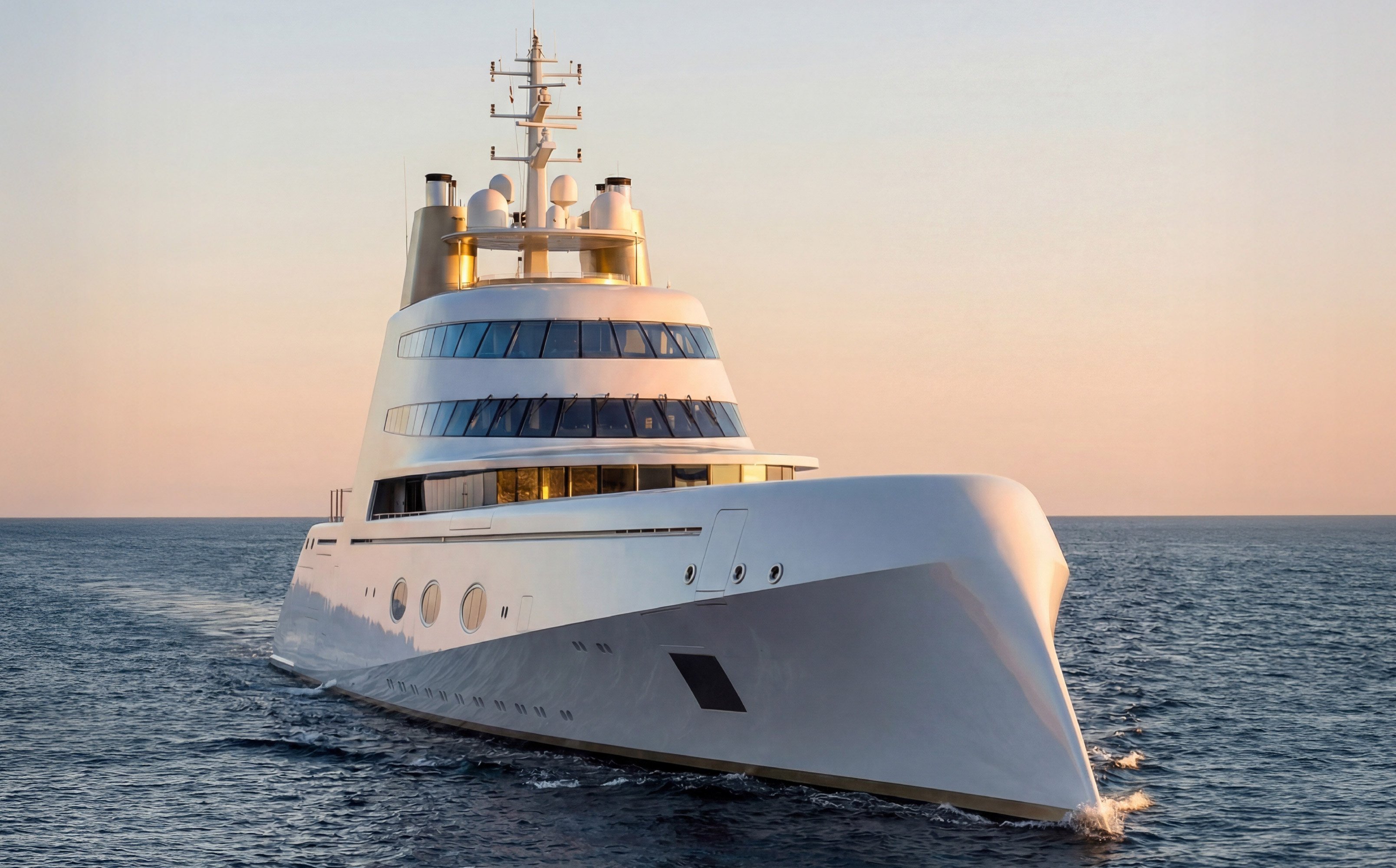
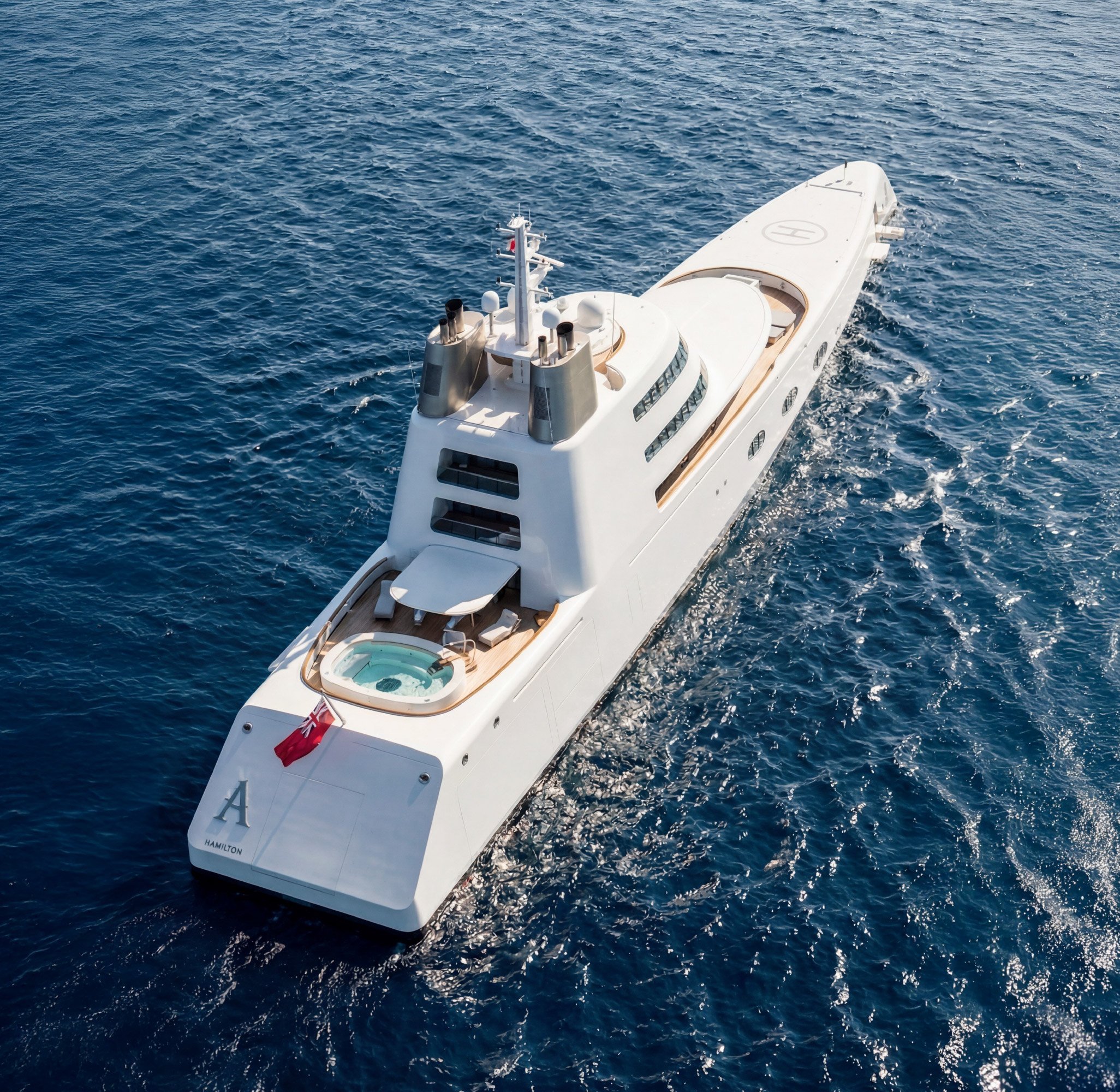
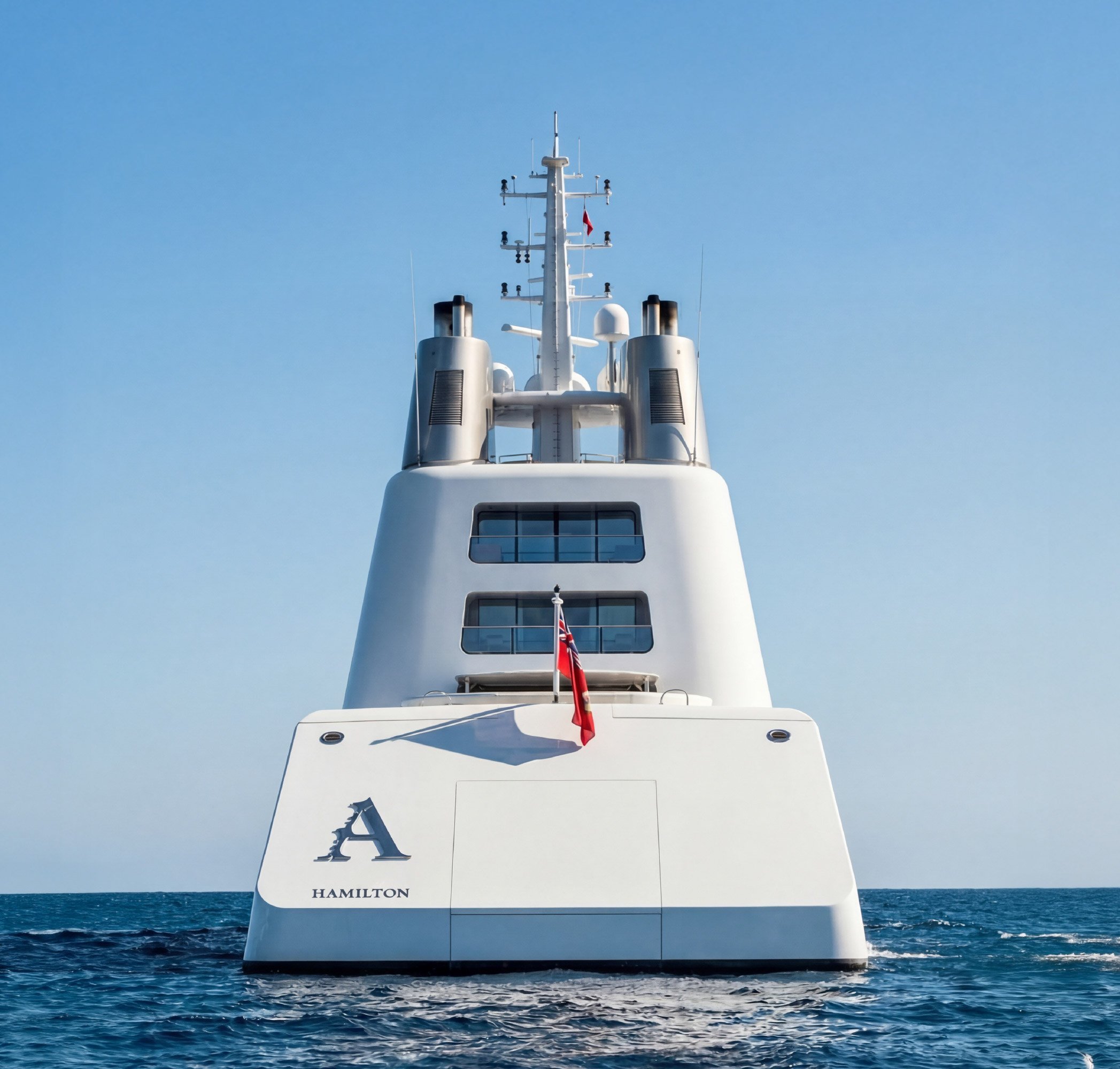
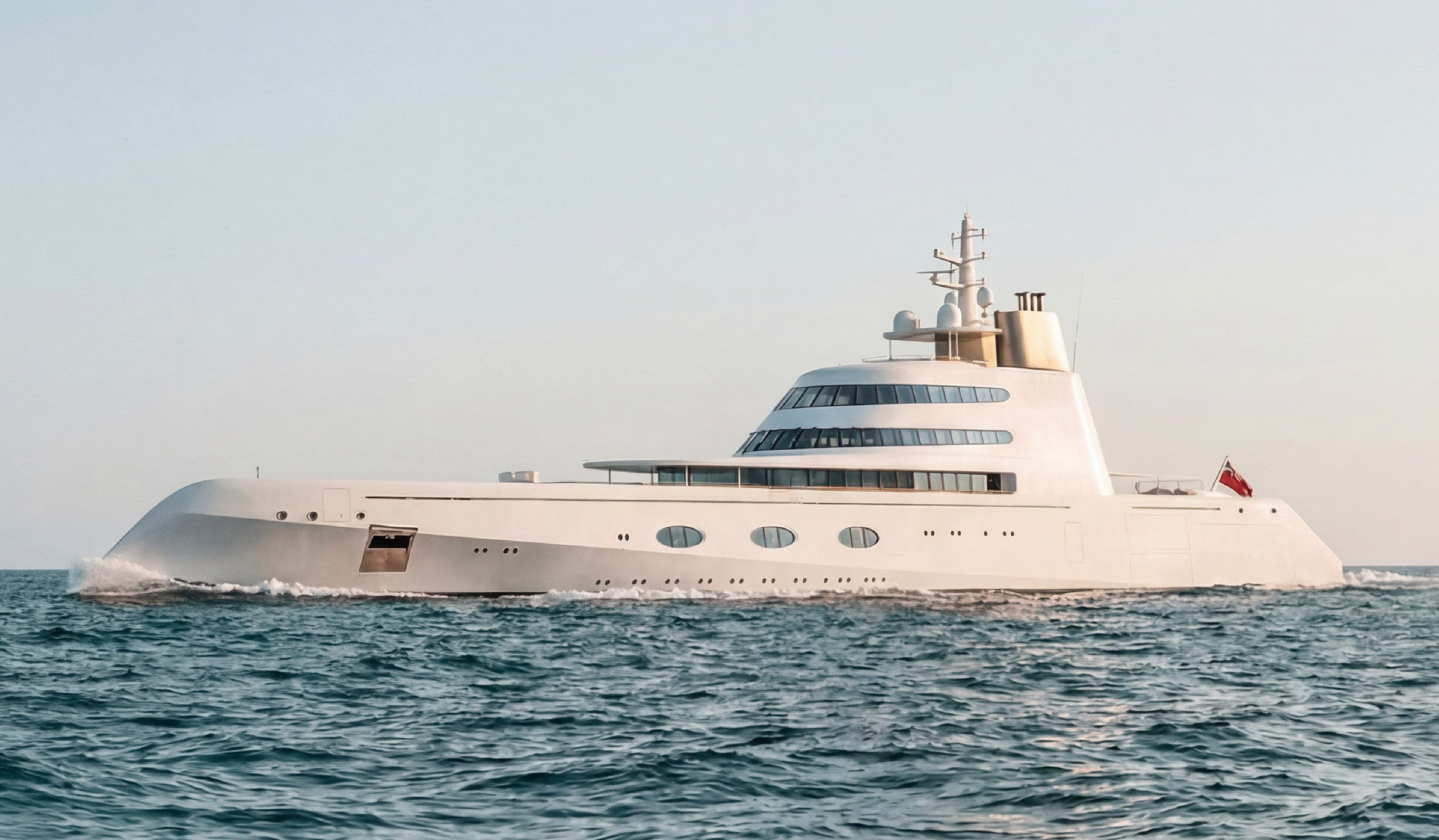
Exterior Design
Exterior Design
Interior Design
Likely to remain private indefinitely.
Interior Design
Likely to remain private indefinitely.
Interior Design
Likely to remain private indefinitely.
Performance
Cruising Speed
16
kn
Max Speed
23
kn
Range
6,500
nm
/
750K
L
(fuel tanks)
Propulsion
Type
Diesel
Motor yacht
Diesel-electric
Horse Power
12,000
HP
Engines info
Performance
Cruising Speed
16
kn
Max Speed
23
kn
Range
6,500
nm
/
750K
L
(fuel tanks)
Propulsion
Type
Diesel
Motor yacht
Diesel-electric
Horse Power
12,000
HP
Engines info
Rumored Owner
LGA Charter Ltd.
See ownership history
Rumored Owner
LGA Charter Ltd.
See ownership history
Fun Facts
🎨 WHO’S BEHIND THE DESIGN?
In November 2004, the design for what would become the most discussed superyacht in history reportedly emerged in a matter of minutes at Philippe Starck’s home in Venice, Italy. Starck (the exterior designer) has noted in subsequent interviews that his conceptual process was nearly instantaneous, a stark contrast to the years of engineering that followed.
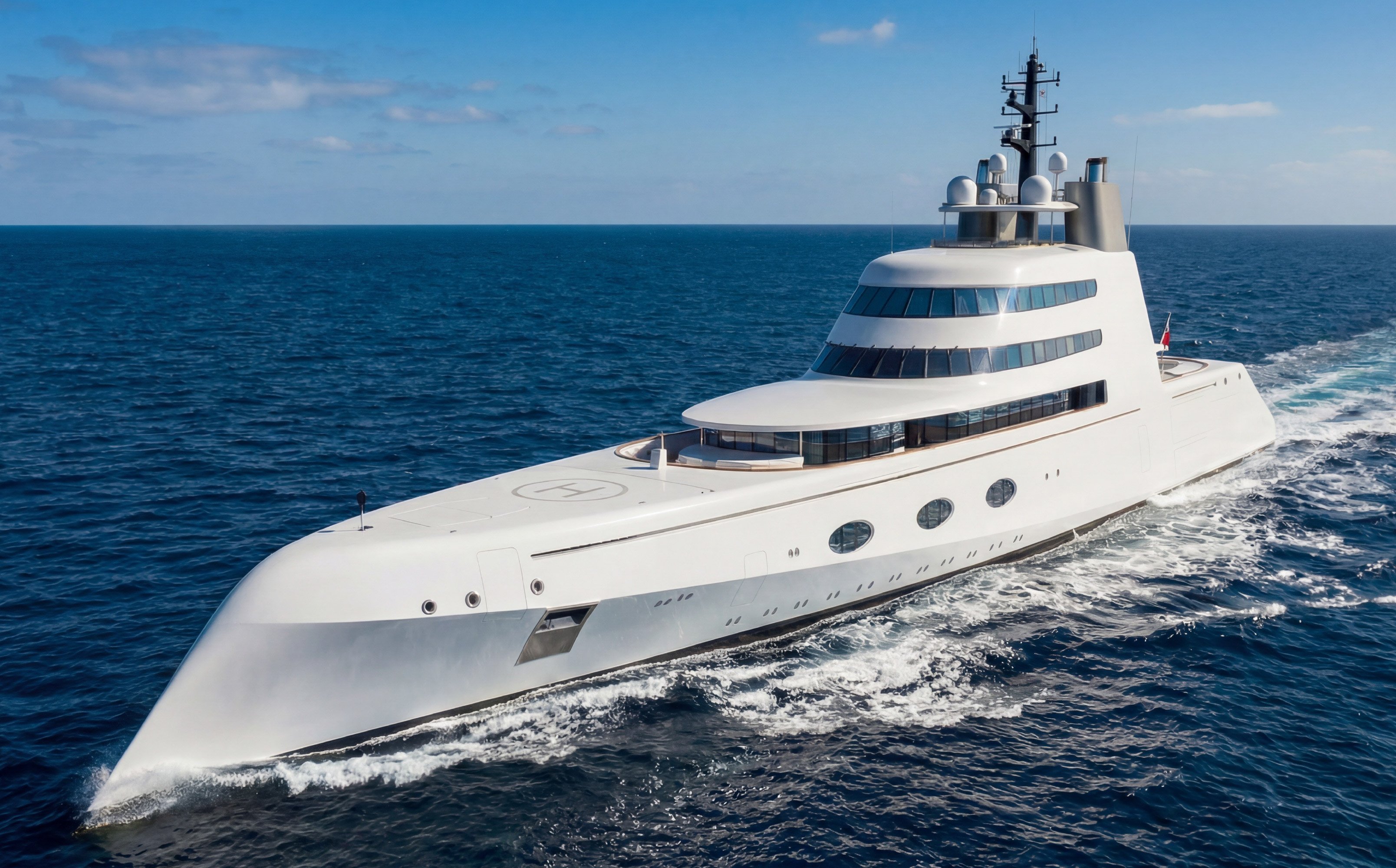
The brief provided by Melnichenko was remarkably minimalist, specifying only a desired length and a requirement for six guest cabins, leaving the rest of the creative execution entirely to Starck’s discretion. This freedom allowed Starck to bypass the conservative ‘wedding cake’ styling prevalent in the early 2000s, where decks were stacked symmetrically with little regard for fluid integration with the marine environment. Starck’s intention was to create a ‘stealth yacht’ that achieved a state of harmony with the sea, drawing inspiration from the hydrodynamic silhouettes of submarines and the natural reflections of whales in the water, with a hull design so smooth that it leaves almost no wake at 25 knots.
The design intentionally obscures the vessel's true scale; from a distance, its ‘tumblehome’ shape and lack of external decks make it difficult to determine its size or the number of people on board.
The chief technical challenge of the build was the reverse bow, inspired in part by the Zumwalt-class destroyers of the US Navy. Martin Francis and the Blohm+Voss team had to ensure that the wave-piercing profile did not compromise the ship's stability or cause it to dive in heavy seas. The result was a hull that reduces vertical acceleration, providing a smoother ride for guests and increasing fuel efficiency by slicing through resistance.
😠 PAINT-LAWSUIT:
One of the most litigious episodes in the yacht's history began in 2013, when Melnichenko’s holding company, Hamilton Yachts Limited, sued the Dutch paint manufacturer AkzoNobel. The owner claimed that the £200 million yacht had received an ‘unsatisfactory’ paint job that left the hull looking ‘cloudy’ with visible ‘lines and sags’.
The lawsuit sought $100 million in damages, which included the £62 million cost of a total repaint and a monthly stipend of £2.5 million to hire a replacement vessel for the 18 months it would take to fix the finish. This case highlighted the obsessive attention to detail required at the pinnacle of superyacht ownership, where even a slightly imperfect finish can trigger a nine-figure legal battle.
We’ll never know how this ended, probably a private out of court settlement.
⭐ AMENITIES AND FEATURES:
The yacht features three swimming pools: one forward of the superstructure and two aft, with one aft pool having a glass bottom that forms a feature ceiling for the disco below, in place since delivery in 2008. There’s also a below‑deck nightclub, with viewing up through the glass‑bottom pool.
There is a helipad on the foredeck, enabling helicopter operations. Large aft decks and hidden terraces integrated into the sloping superstructure provide multiple outdoor lounging zones while preserving the stark, naval‑inspired exterior lines.
Starck used extensive mirrored wall and ceiling panels throughout the interior, a hallmark of his 2000s work that gives a deliberately disorienting, highly reflective environment.
A well‑known anecdote from early press coverage is the existence of a ‘secret room’ hidden behind mirrored panels in the interior. The exact function of the room has never been officially documented in detail, adding to the yacht’s mystique and feeding rumors of private clubs, panic rooms or private cinemas behind hidden doors.
Motor Yacht “A” carries custom tenders designed by Philippe Starck, including at least one enclosed limo tender and one 11 m open tender delivered with the yacht.
🧑🏽🎨 ART DELIVERY:
Upon delivery in 2008, the vessel's maiden voyage was not merely a leisure trip but a logistics operation for high-value fine art. The yacht sailed to Kristiansand, Norway, specifically to collect three Claude Monet paintings that Andrey and Aleksandra Melnichenko had recently acquired at auction. This solidified the yacht’s reputation as a secure, mobile treasury for the couple's burgeoning art collection.
💥 THE ESCAPE:
The ownership narrative of Motor Yacht “A” took a dramatic turn in March 2022, following the imposition of European Union sanctions against Andrey Melnichenko. While his larger asset, Sailing Yacht “A”, was seized by Italian authorities in Trieste and remains there as of early 2026 (costing the Italian state approximately $900,000 per month in maintenance) Motor Yacht “A” managed to evade capture.
The vessel sought refuge in Dubai, United Arab Emirates, where it remained for more than two years. During this period, the yacht was deregistered by the Isle of Man and reportedly transitioned through various flags, including Sierra Leone, before settling under a Malaysian registry.
In January 2025, the yacht finally departed Dubai after extensive maintenance, moving into international waters in the Gulf of Oman.
Also, the vessel's registration was updated to show a new owner, LGA Charter Ltd, and representative statements from Melnichenko indicated that he no longer holds any relation to the ship. This shift suggests a ownership change or a change of strategy by the owner for his vessel. PS: I doubt this yacht will ever be for charter.
🎨 WHO’S BEHIND THE DESIGN?
In November 2004, the design for what would become the most discussed superyacht in history reportedly emerged in a matter of minutes at Philippe Starck’s home in Venice, Italy. Starck (the exterior designer) has noted in subsequent interviews that his conceptual process was nearly instantaneous, a stark contrast to the years of engineering that followed.
The brief provided by Melnichenko was remarkably minimalist, specifying only a desired length and a requirement for six guest cabins, leaving the rest of the creative execution entirely to Starck’s discretion. This freedom allowed Starck to bypass the conservative ‘wedding cake’ styling prevalent in the early 2000s, where decks were stacked symmetrically with little regard for fluid integration with the marine environment. Starck’s intention was to create a ‘stealth yacht’ that achieved a state of harmony with the sea, drawing inspiration from the hydrodynamic silhouettes of submarines and the natural reflections of whales in the water, with a hull design so smooth that it leaves almost no wake at 25 knots.
The design intentionally obscures the vessel's true scale; from a distance, its ‘tumblehome’ shape and lack of external decks make it difficult to determine its size or the number of people on board.
The chief technical challenge of the build was the reverse bow, inspired in part by the Zumwalt-class destroyers of the US Navy. Martin Francis and the Blohm+Voss team had to ensure that the wave-piercing profile did not compromise the ship's stability or cause it to dive in heavy seas. The result was a hull that reduces vertical acceleration, providing a smoother ride for guests and increasing fuel efficiency by slicing through resistance.
🧑🏽🎨 ART DELIVERY:
Upon delivery in 2008, the vessel's maiden voyage was not merely a leisure trip but a logistics operation for high-value fine art. The yacht sailed to Kristiansand, Norway, specifically to collect three Claude Monet paintings that Andrey and Aleksandra Melnichenko had recently acquired at auction. This solidified the yacht’s reputation as a secure, mobile treasury for the couple's burgeoning art collection.
😠 PAINT-LAWSUIT:
One of the most litigious episodes in the yacht's history began in 2013, when Melnichenko’s holding company, Hamilton Yachts Limited, sued the Dutch paint manufacturer AkzoNobel. The owner claimed that the £200 million yacht had received an ‘unsatisfactory’ paint job that left the hull looking ‘cloudy’ with visible ‘lines and sags’.
The lawsuit sought $100 million in damages, which included the £62 million cost of a total repaint and a monthly stipend of £2.5 million to hire a replacement vessel for the 18 months it would take to fix the finish. This case highlighted the obsessive attention to detail required at the pinnacle of superyacht ownership, where even a slightly imperfect finish can trigger a nine-figure legal battle.
We’ll never know how this ended, probably a private out of court settlement.
💥 THE ESCAPE:
The ownership narrative of Motor Yacht “A” took a dramatic turn in March 2022, following the imposition of European Union sanctions against Andrey Melnichenko. While his larger asset, Sailing Yacht “A”, was seized by Italian authorities in Trieste and remains there as of early 2026 (costing the Italian state approximately $900,000 per month in maintenance) Motor Yacht “A” managed to evade capture.
The vessel sought refuge in Dubai, United Arab Emirates, where it remained for more than two years. During this period, the yacht was deregistered by the Isle of Man and reportedly transitioned through various flags, including Sierra Leone, before settling under a Malaysian registry.
In January 2025, the yacht finally departed Dubai after extensive maintenance, moving into international waters in the Gulf of Oman.
Also, the vessel's registration was updated to show a new owner, LGA Charter Ltd, and representative statements from Melnichenko indicated that he no longer holds any relation to the ship. This shift suggests a ownership change or a change of strategy by the owner for his vessel. PS: I doubt this yacht will ever be for charter.
⭐ AMENITIES AND FEATURES:
The yacht features three swimming pools: one forward of the superstructure and two aft, with one aft pool having a glass bottom that forms a feature ceiling for the disco below, in place since delivery in 2008. There’s also a below‑deck nightclub, with viewing up through the glass‑bottom pool.
There is a helipad on the foredeck, enabling helicopter operations. Large aft decks and hidden terraces integrated into the sloping superstructure provide multiple outdoor lounging zones while preserving the stark, naval‑inspired exterior lines.
Starck used extensive mirrored wall and ceiling panels throughout the interior, a hallmark of his 2000s work that gives a deliberately disorienting, highly reflective environment.
A well‑known anecdote from early press coverage is the existence of a ‘secret room’ hidden behind mirrored panels in the interior. The exact function of the room has never been officially documented in detail, adding to the yacht’s mystique and feeding rumors of private clubs, panic rooms or private cinemas behind hidden doors.
Motor Yacht “A” carries custom tenders designed by Philippe Starck, including at least one enclosed limo tender and one 11 m open tender delivered with the yacht.
All media not captured by this website remain the sole property of their respective owners, as credited. No licenses, copyrights, or other usage rights are granted to users of this site. All rights are reserved by the original creators.
Majority of the pictures displayed on this website are AI-generated illustrations used for visual representation purposes only. Not real pictures, unless explicitly stated otherwise. The appearance of the actual yacht may differ from those shown in the illustrations.
This page is provided for general informational purposes only and does not constitute a formal listing for sale or charter. I am not the manager, owner, nor representative of this vessel. While the data provided is gathered from publicly available sources, I cannot guarantee that all information is accurate, complete, or up to date at all times.
All media not captured by this website remain the sole property of their respective owners, as credited. No licenses, copyrights, or other usage rights are granted to users of this site. All rights are reserved by the original creators.
Majority of the pictures displayed on this website are AI-generated illustrations used for visual representation purposes only. Not real pictures, unless explicitly stated otherwise. The appearance of the actual yacht may differ from those shown in the illustrations.
This page is provided for general informational purposes only and does not constitute a formal listing for sale or charter. I am not the manager, owner, nor representative of this vessel. While the data provided is gathered from publicly available sources, I cannot guarantee that all information is accurate, complete, or up to date at all times.

The Yacht Info
Copyright © 2026 The Yacht Info
All rights reserved
The Yacht Info
Copyright © 2026 The Yacht Info
All rights reserved